
Industrial Pallet Corp accelerates incremental technology upgrades with help of $150,000 Manufacturing Readiness Grant
Industrial Pallet Corp.
Case Study
Key Stats
$150,000
Grant Amount
Tippecanoe
County
550
Company Size
Q3, 2023
Award Date
Company History
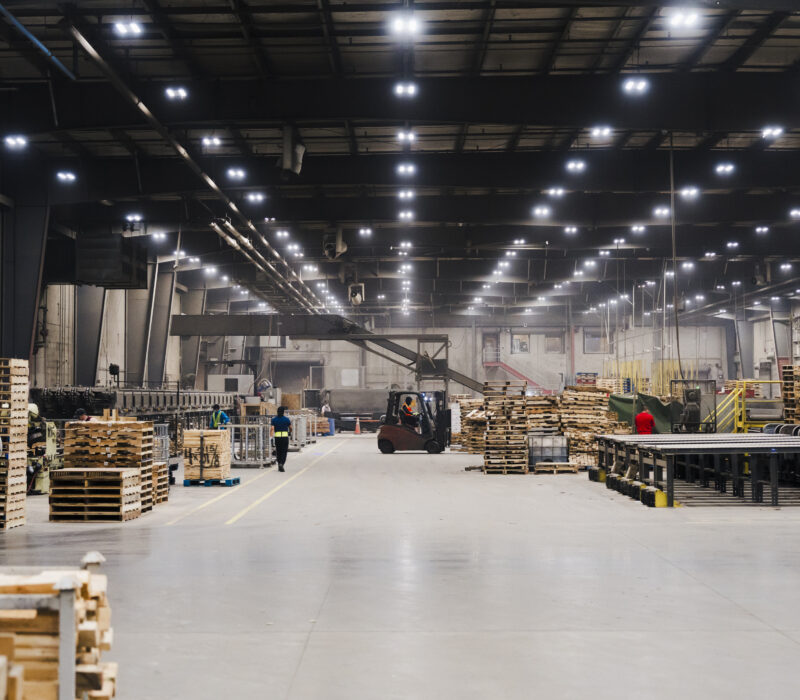
American Fibertech Corporation’s (AFC) Industrial Pallet Corp. (IPC) operations were founded in 1986 to provide custom pallets for storage and shipping.
Founder Jon Schwab started AFC in his farm shop in Remington, Indiana with 7 employees. In the early days of IPC, the wood pallet industry dealt in two types of pallets: new and recycled. “A new pallet is made from new lumber, new materials,” IPC co-owner and COO Jay Wiegand explained. “A recycled pallet is one that’s had prior use and is reconditioned or repaired for continued use. Repair usually consists of replacing damaged or broken boards using new or recycled material. When industry began to recycle pallets in the 1990s, it was common for recycling to be treated almost as a favor to the initial user. As a result, companies ordinarily paid the recycler to take the damaged or worn pallet.
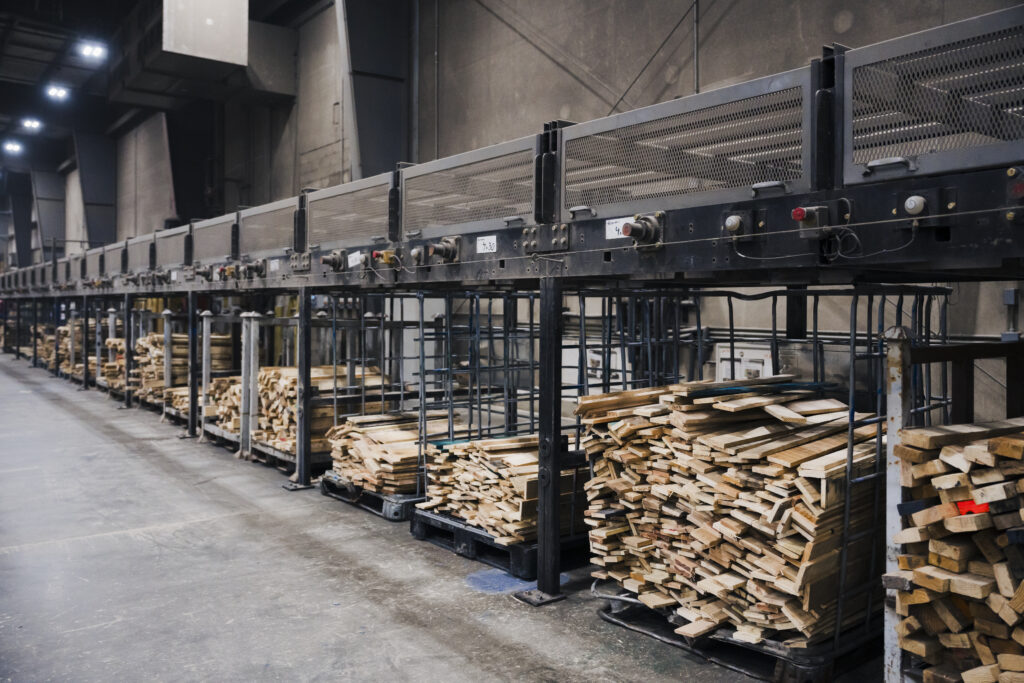
Eventually, a third type of pallet was introduced – the remanufactured pallet. “In remanufacturing, you are building a pallet to a customer’s specification out of either 100% or partially recycled materials.” With used pallets now providing more potential value as raw materials, this generated a competitive marketplace where local pallet manufacturers compete on service, logistics, cost, quality and reporting transparency, just to win the rights to purchase used pallets from distributors.
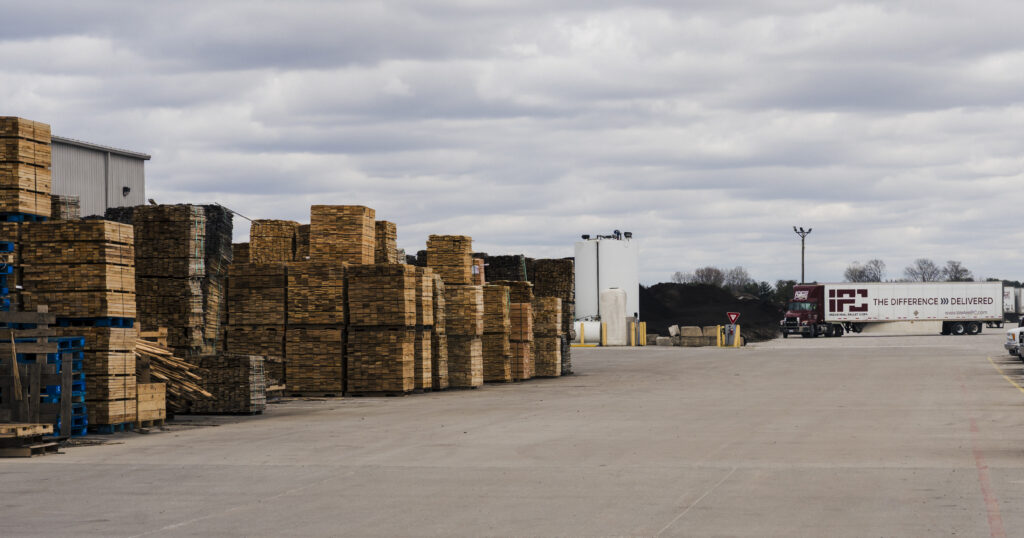
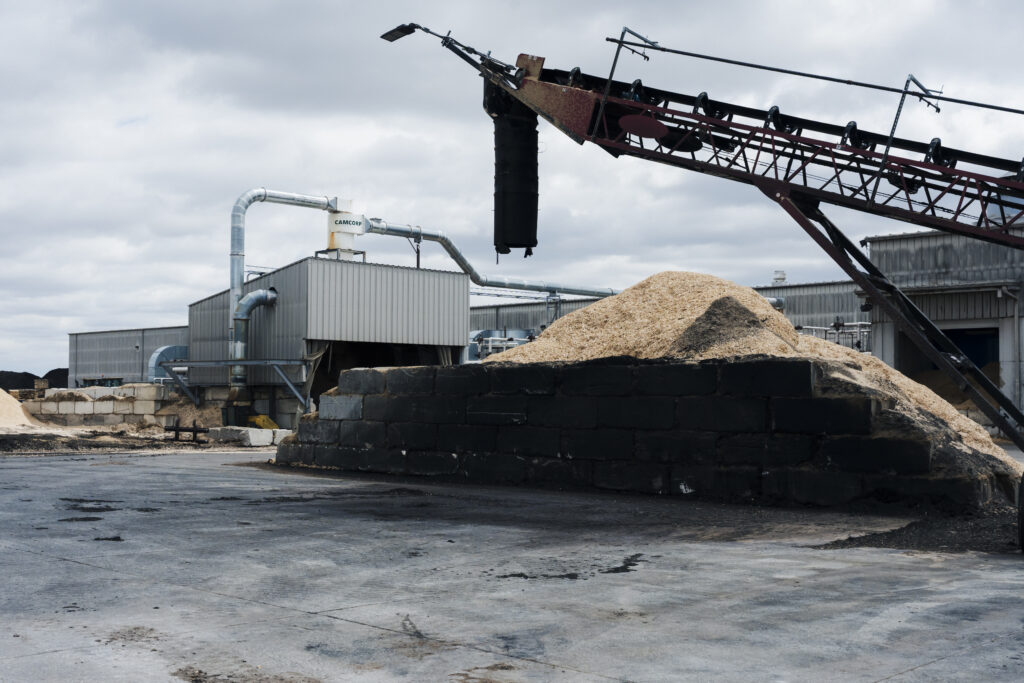
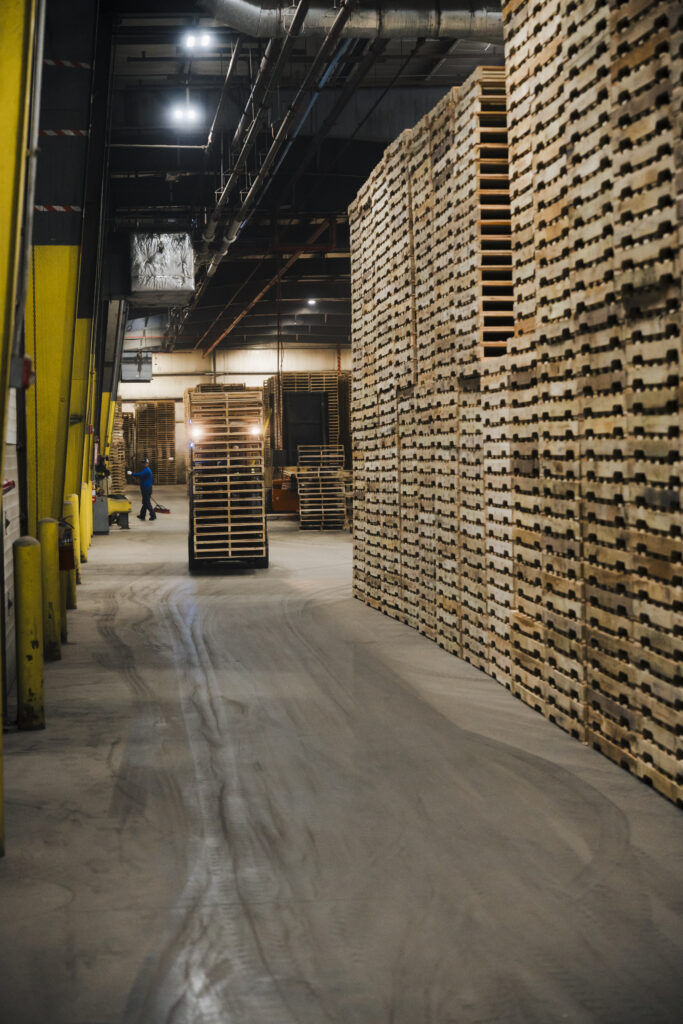
The company has since grown to 4 locations with 550 employees – IPC is among the largest pallet operations in the state of Indiana, building an average of 40,000 pallets each day and operating as a “super-regional” producer with a significant industry footprint. But there is no shortage of other pallet producers in Indiana – an additional 225 companies exist in the state, with some producing as few as 250 pallets per week, comparatively. “The crowded landscape keeps the industry highly regionally competitive,” Jay said. “Pallets to be remanufactured are primarily received from within 100 miles or less. That’s why we have 3 different facilities in Indiana.” The company’s Indiana plants are in Clark Hill, Mitchell and Remington, with headquarters in Lafayette.
Pre-Grant Innovation
IPC kept a steady approach while implementing its innovation strategy, ensuring each phase of equipment would build on the success and learnings from the one before it.
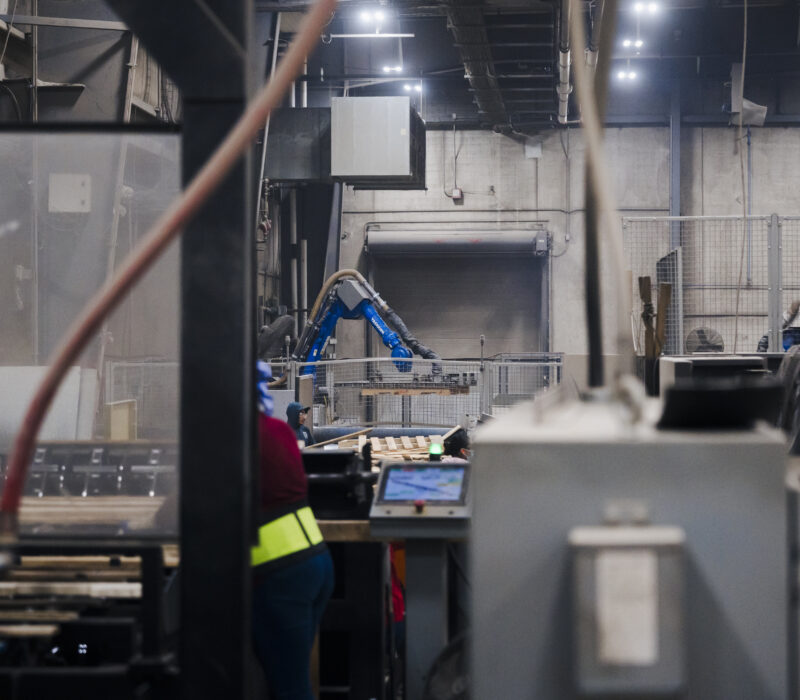
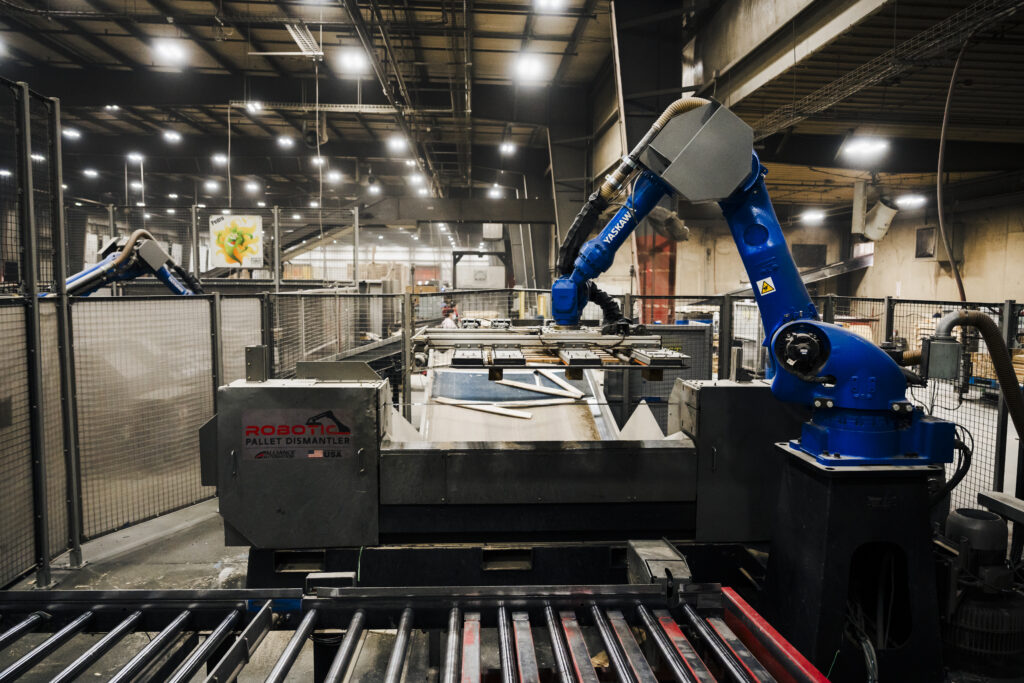
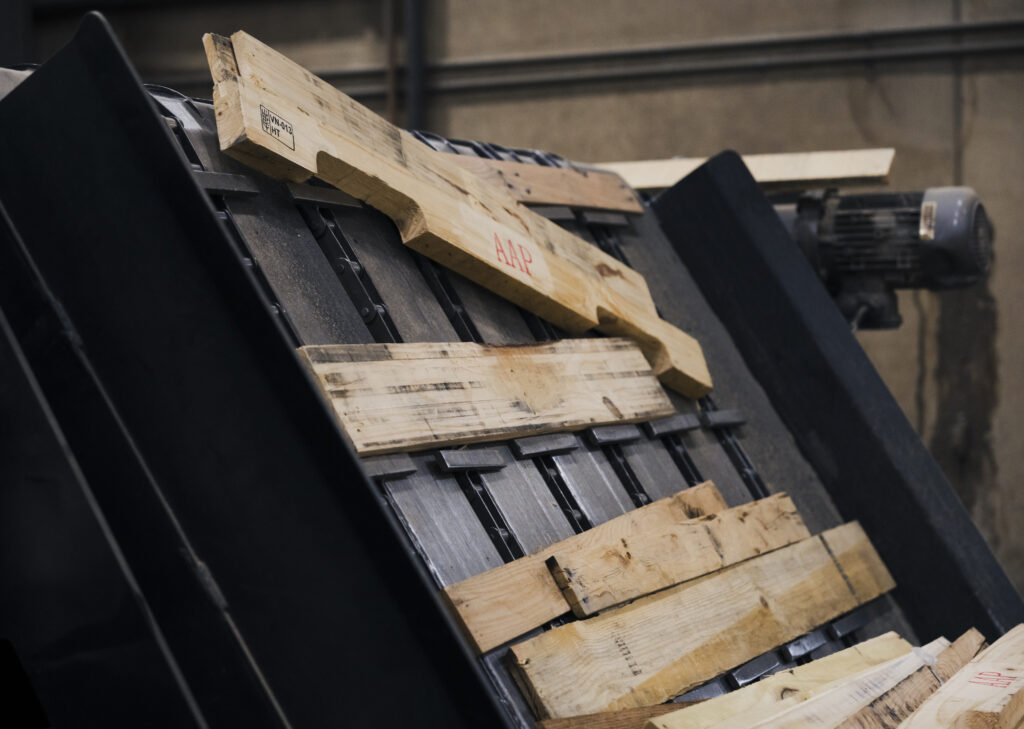
IPC set the stage for their eventual MRG project with the acquisition of an Urban Sawmill paired with a Robotic Disassembly System (RDS) to aid in pallet breakdown and organization. The process begins as the RDS picks up a to-be-recycled pallet and articulates it above an integrated band saw, incrementally trimming the pallet and breaking it down into individual board components. From there, the boards are fed to the sawmill on a conveyor, where a laser camera individually measures and records critical board dimensions. Using these measurements, the sawmill selectively trims board lengths to optimize reuse potential. As an example, if the camera reads that a board is 43 inches long, and a desired pallet build requires a board that is 42 inches long, the sawmill will remove 1 inch off the board to meet that specification.
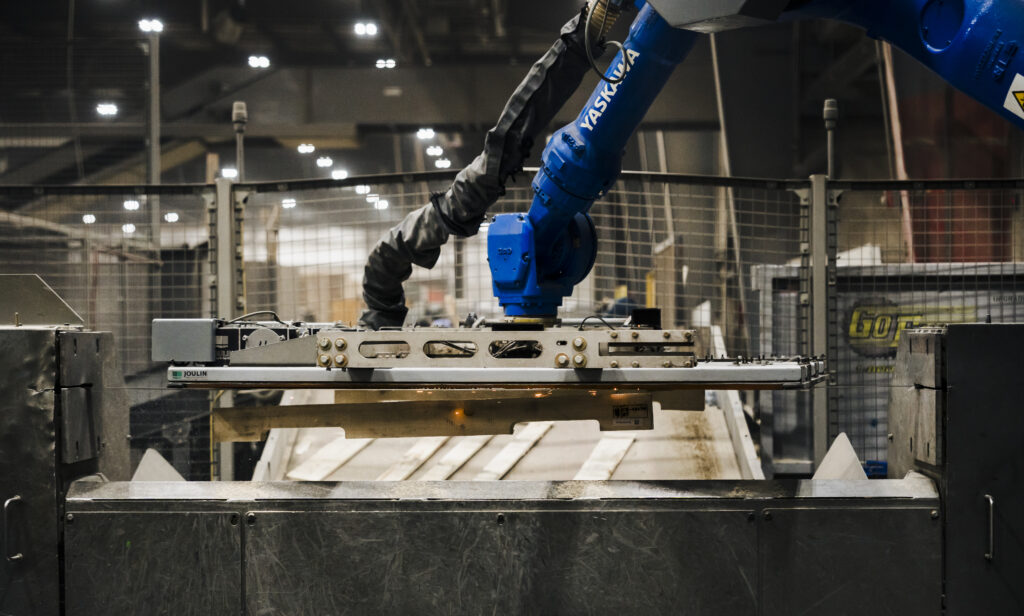
The sawmill considers several variables against potential future pallet builds to make the best decision for how to reuse each individual board. Jay acknowledged that IPC had some employees who were skilled at manually performing those functions prior to the introduction of this system, but it was a difficult and sometimes risky task. The sawmill and RDS made for “a significant productivity gain, and it also made the job safer and easier for our employees. We were able to take people off that line and put them in jobs where they could do more rewarding things instead of sorting lumber and dismantling pallets.”
Manufacturing Readiness Grants (MRG) provided by the Indiana Economic Development Corporation and administered by Conexus Indiana are available to incentivize, de-risk and accelerate the adoption of innovative manufacturing technology for small- to mid-sized manufacturers in Indiana. Building on prior improvements, American Fibertech Corporation, dba Industrial Pallet Corp., applied its $150,000 MRG to modernize its pallet assembly processes and data collection abilities.
The MRG Project
Armed with more pallet boards and a digital database of their dimensions, IPC chose to continue scaling their remanufactured pallet production.
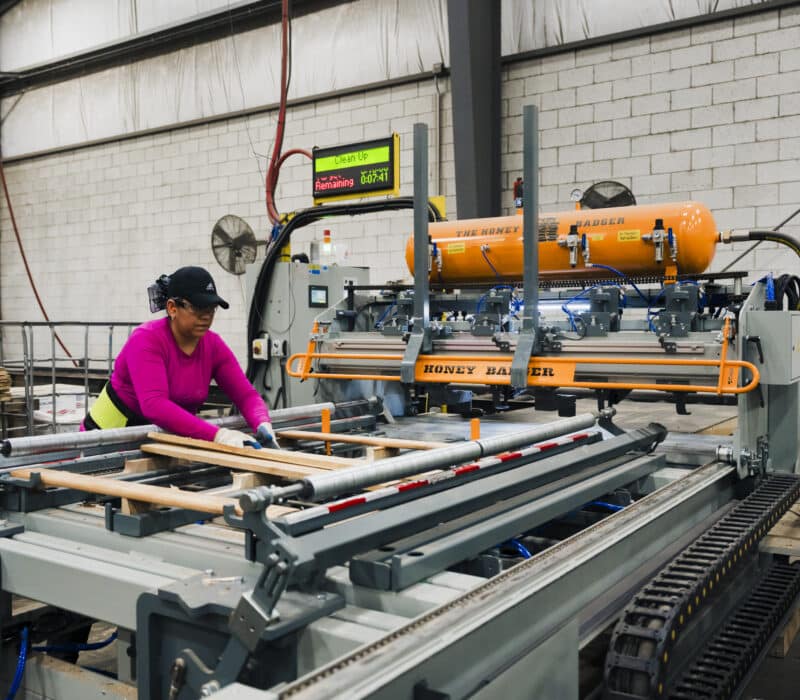
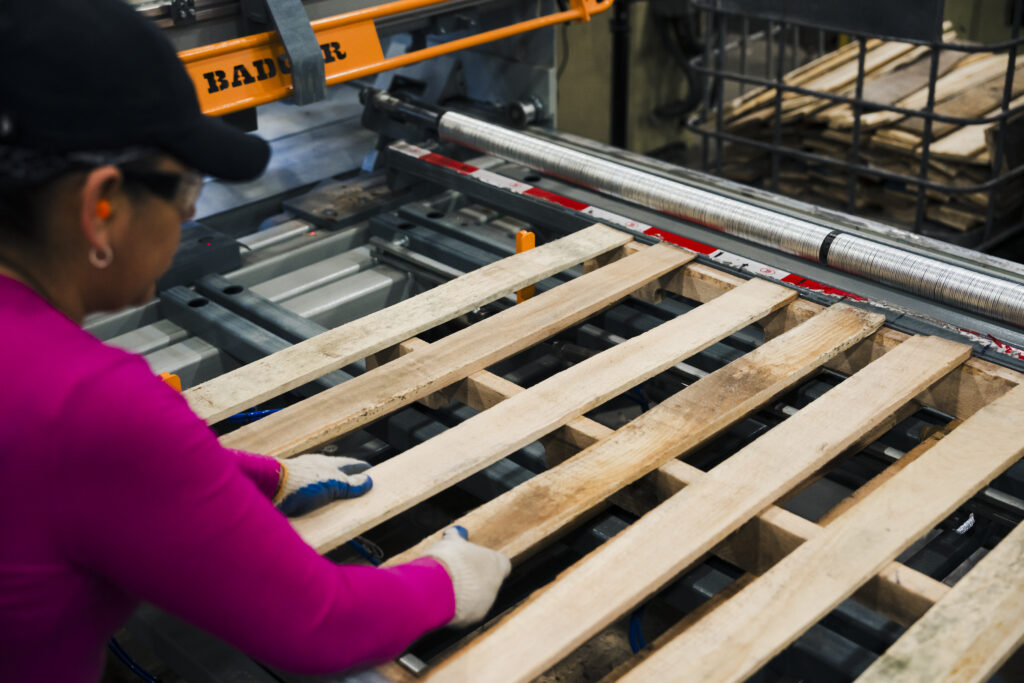
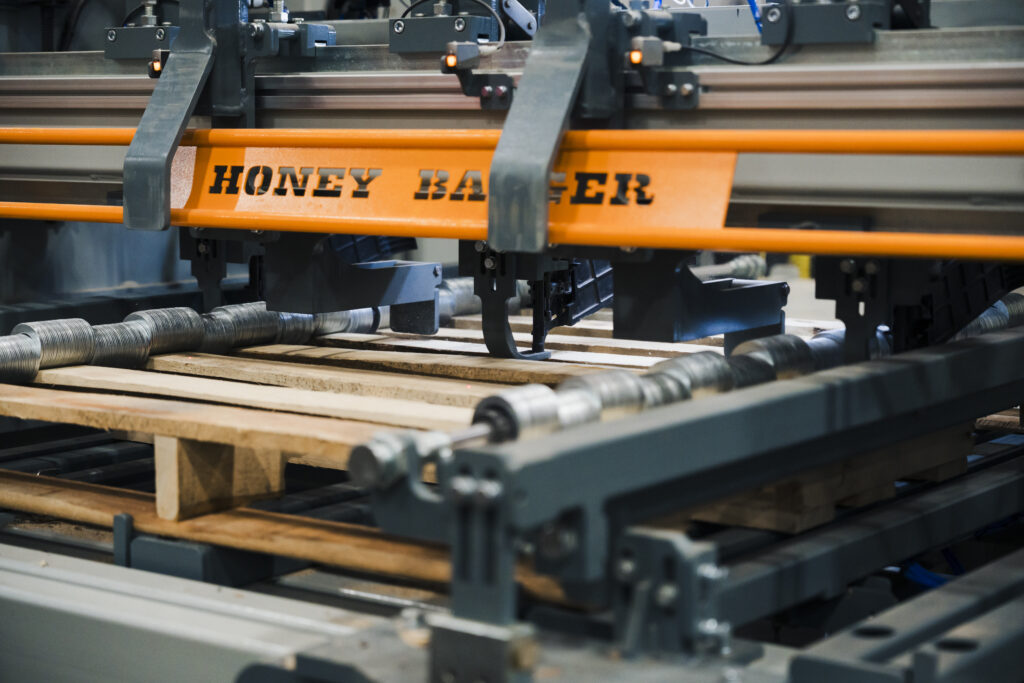
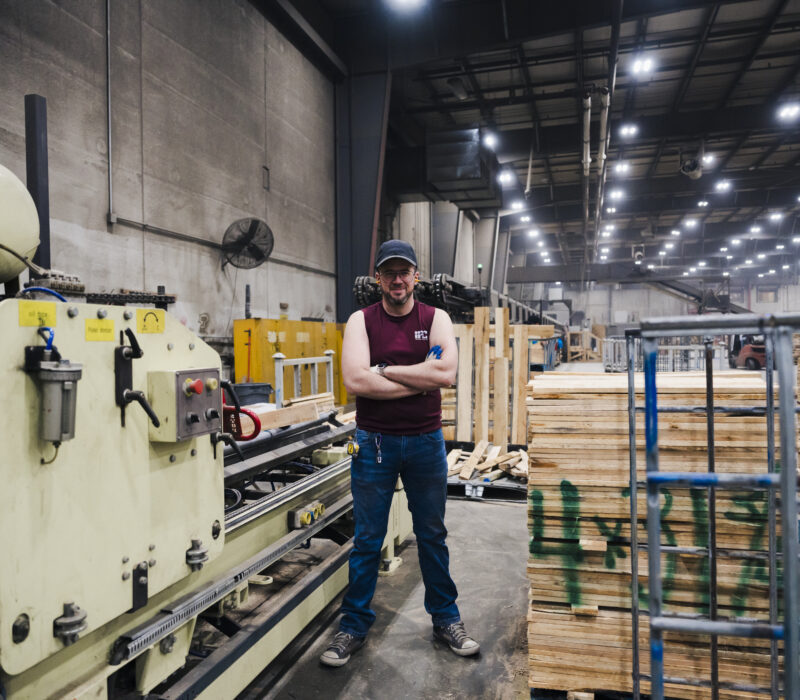
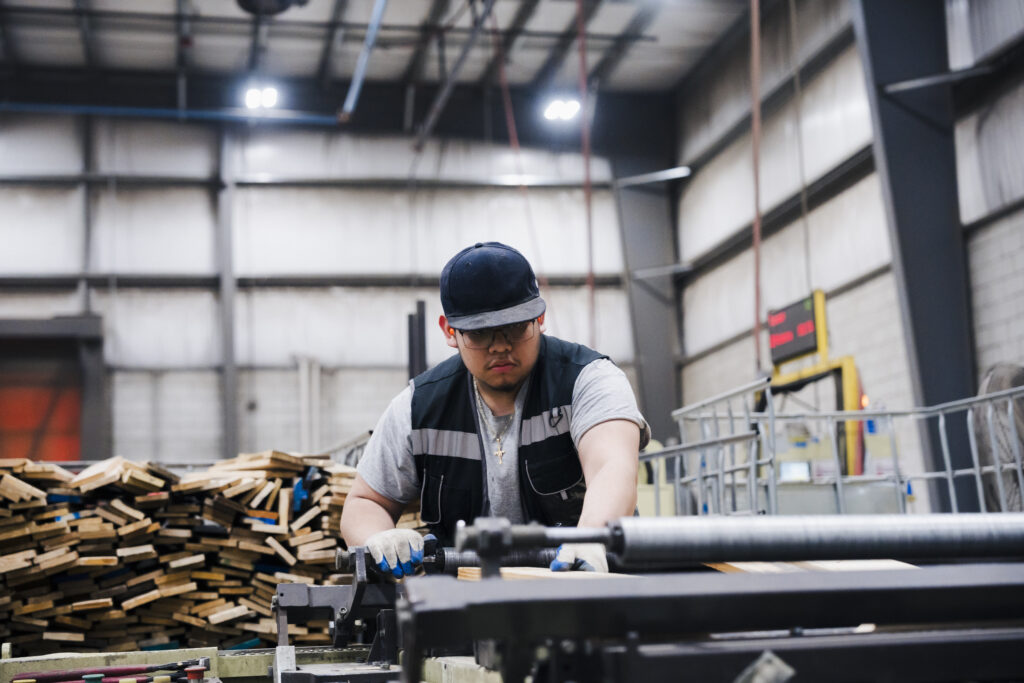
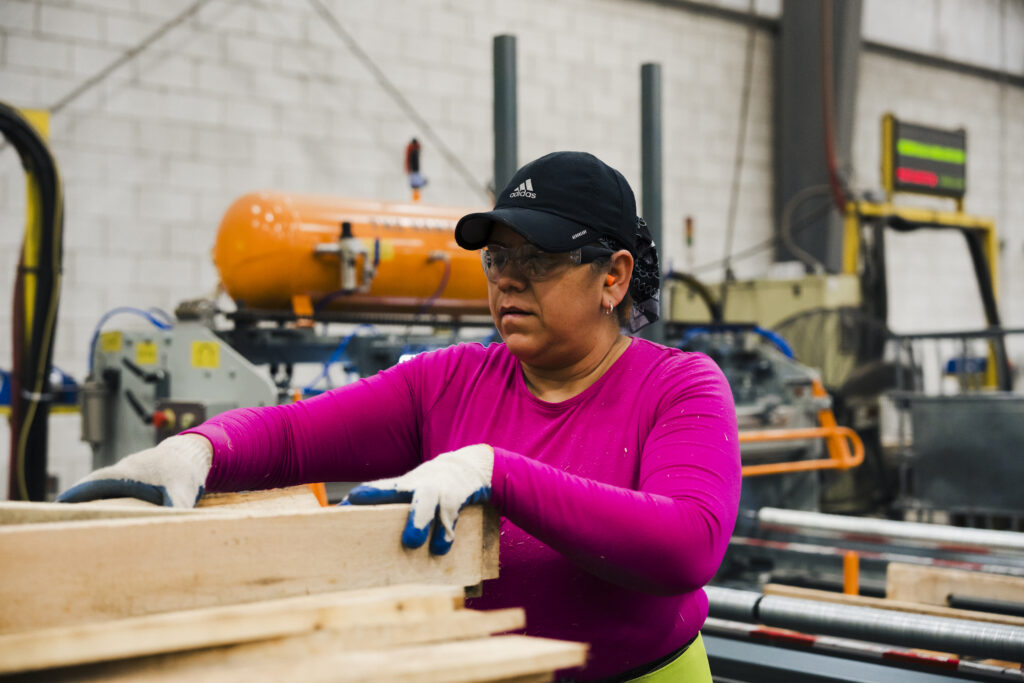
IPC’s Manufacturing Readiness Grant supported their second phase of pallet processing automation – the fixturing, assembly and nailing of remanufactured pallets. Historically, this work had been accomplished all by hand, with an operator setting up a pallet jig, assembling a pallet from reclaimed pieces, and using a handheld pneumatic nail gun to fasten the boards together. This work was incredibly physically demanding, involved product variance due to human elements, and resulted in 125-130 assembled pallets per 8-hour shift. With support from the MRG, IPC was able to integrate four turnkey Honey Badger pallet nailing machines into a single manufacturing cell. Now, pallet boards are selected and assembled by an operator while these machines intelligently determine proper fastener coverage and automatically nail the pallet together. Production is now in the 250-300 pallet range per 8-hour shift, more than doubling previous rates.
Once a pallet is assembled, a multipurpose barcode is applied that IPC uses to track and route each pallet to its proper stacking location. These barcodes are also critical in providing valuable internal operations data as they’re scanned at certain points through production – allowing IPC to optimize build times, inform their quality assurance processes and ensure product traceability. In anticipation of this project, IPC made significant modifications to their ERP system to best utilize the new cycle time and pallet data they’d have access to. Their XL Vorne Production Monitoring System leverages this data to visualize real-time production metrics and overall equipment effectiveness for plant managers and supervisors.
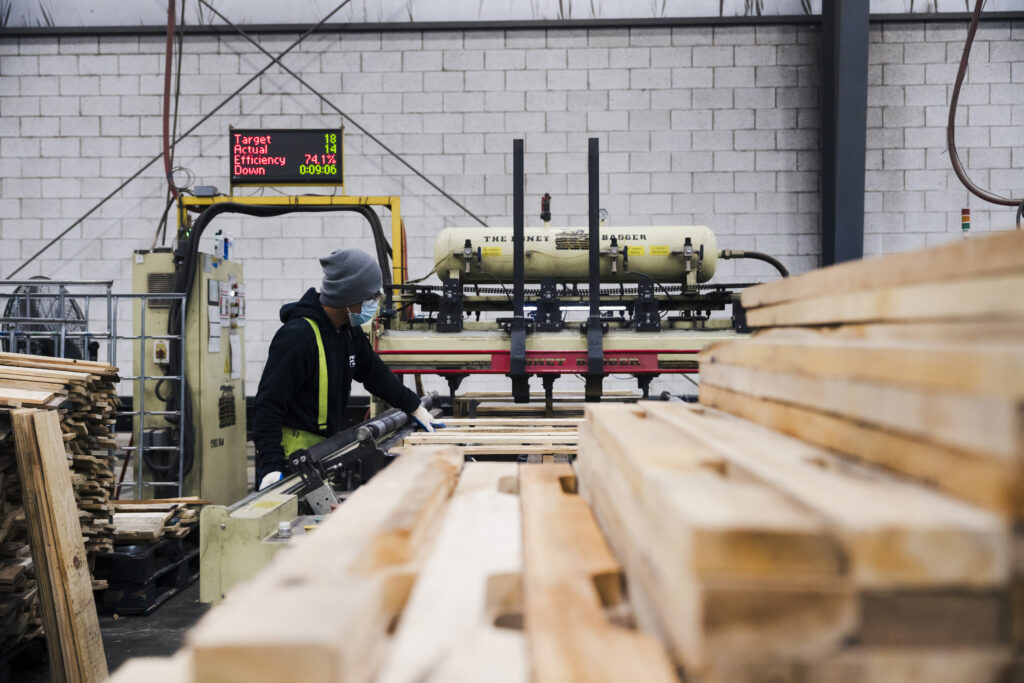
The total integration of all individual pieces of equipment is an essential part of these projects’ success, Jay said. “We have a similar pallet nailing machine in another factory that operates at lower production numbers. It doesn’t have the Urban Sawmill or Robotic Disassembly System upstream. For the dimensional lumber needed, it has a manual process. And that means a human operator ends up sorting it over, and over, and over again. The operator is feeding the machine while having to check multiple board dimensions at the same time – they have a ¾ board with all these ½-inch boards. They must set it aside and that kinks the whole chain in productivity.”
Shared Learnings and Workforce Implications
Despite early learning challenges, all affected employees have been pleased with the completed projects.
Taking gradual steps to digitally transform the workplace not only grows a company’s knowledge base for future advances but helps to keep technology adoption from appearing overwhelming or too sudden. “I don’t know that anyone wants these machines to go away,” Jay said. “Most people take some time to get used to change, but once they see the process and understand the benefits this advanced equipment can provide, most don’t want to go back to the prior system. And no one was replaced.”
While the final integration of the MRG Project required just 2 weeks to complete, years of due diligence contributed to this efficiency.
The project process heavily benefitted from the groundwork laid by prior advancements. Jay credited the company’s strategy for the relatively smooth way each step was incorporated and coordinated, seamlessly merging with earlier innovations. He added his praises for the new barcoding abilities available to IPC. “It tracks the pallet as it progresses through the system,” he said. “It’s a simple cycle counter and has the flexibility to measure equipment performance indicators with the barcode.”
IPC is now exploring new market opportunities, though continued expansion will depend on raw material availability. “With greater capacity and data-driven operations, we’re positioned for growth,” Wiegand said. “But we remain thoughtful and strategic about where we go next.”
“We continue to invest in the company and have 550 teammates now instead of 100 – that growth doesn’t happen by doing things the exact same way we did in the past.”
Jay Wiegand
Chief Operating Officer at IPC
